Show summary Hide summary
A small, unremarkable stone recovered in Mali in 2022 is reshaping scientists’ picture of early Mars. New analyses place the meteorite — known as Teghaza 001 — at least 4.1 billion years old, and a study published Oct. 29 in Science confirms the rock interacted with water on the young planet.
A rare Martian fragment and its age
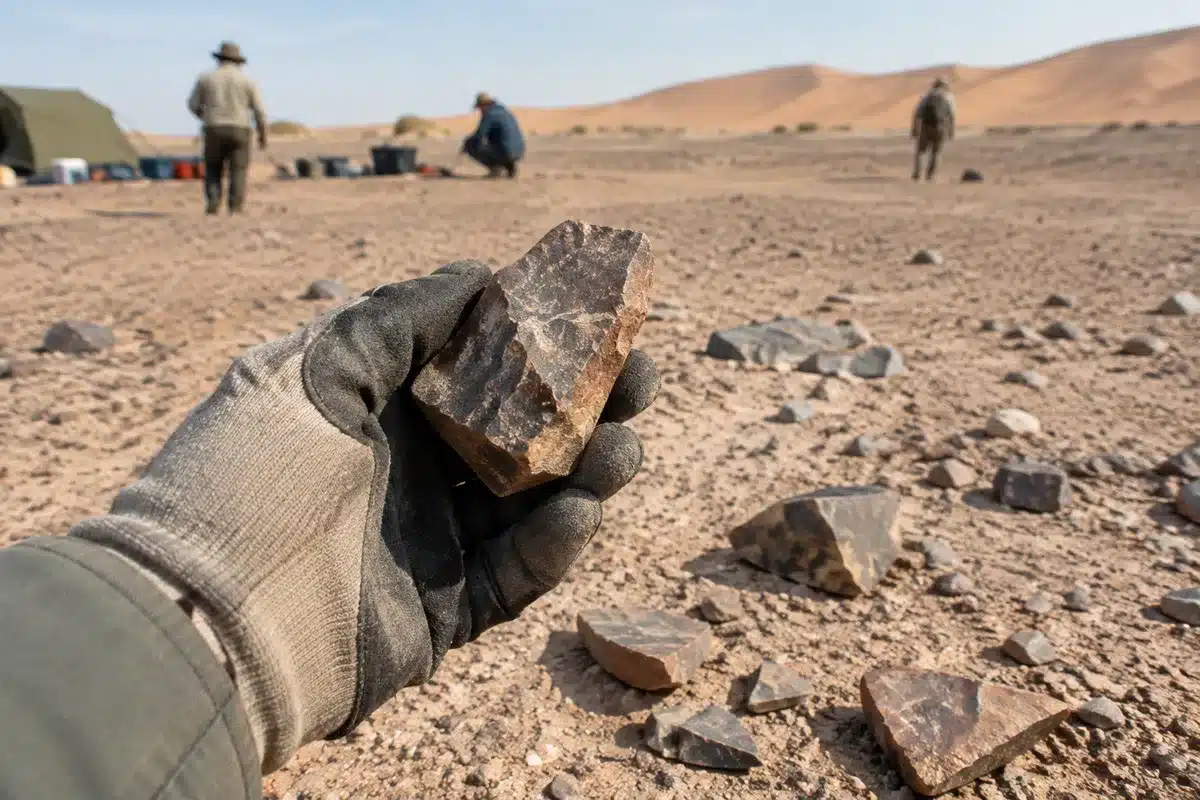
Teghaza 001 arrived on Earth as eight fragments totaling about 800 grams, found near the Taghaza archaeological site and now held by the Maine Mineral and Gem Museum. Researchers who examined minerals within the specimen measured several radioactive decay systems, including tiny, durable crystals called zircons, and reported a consistent age of roughly 4.1 billion years in a preprint posted April 14.
Saharan meteorite hints Mars may have lost water more than 4bn years ago
Apple’s latest announcements include OLED updates, new MacBooks and a touchscreen

The combination of independent dating techniques makes Teghaza 001 a candidate for the oldest single piece of Mars yet identified. Subsequent work published in Science on Oct. 29 further reported chemical signs that the meteorite had interacted with liquid water more than four billion years ago.
Silica-rich rock hints at complex early geology
Unlike the basalt that covers much of Mars today, Teghaza 001 is unusually rich in silica. That composition resembles terrestrial rocks such as granite, which on Earth often form from slow cooling of hot, pressurized melts deep in the crust—processes usually linked to plate tectonics.
But Mars does not show evidence of modern plate tectonics, and its surface is dominated by quickly cooled volcanic basalt. That contrast has pushed scientists to reconsider how silica-rich crustal rocks might form on a smaller, tectonically inactive planet.
Subsurface magma networks without plates
New modeling using seismic data from NASA’s InSight lander, published June 26 in Nature Astronomy, suggests Mars may once have hosted vast, interconnected magma systems beneath its northern hemisphere. Those networks could have driven long-lived crustal melting even in the absence of plate-driven recycling.
Study co-author Jon Wade, an Oxford University planetary materials researcher, framed the finding in planetary-context terms: “One of the big questions in planetary science is whether Earth is unique.” He added that if Mars produced complex crustal rocks without plates, the range of planets capable of developing habitable conditions may be broader than previously thought.
A record of early water loss
Another line of inquiry examined Mars’ hydrogen budget. In a June 10 paper in Science Advances, scientists measured ratios of hydrogen to its heavier sibling, deuterium, in Teghaza 001 and in two younger Martian meteorites. Because light hydrogen escapes to space more readily than deuterium, changing ratios can trace atmospheric loss.

The team concluded that Mars shed a substantial portion of its original, or juvenile, atmosphere within a few hundred million years after the planet’s early magma ocean solidified. Their measurements indicate significant hydrogen loss was already underway by about 4.1 billion years ago.
What Teghaza can — and cannot — tell us
Taken together, these studies paint a picture of an early Mars that could produce silica-rich crust, sustain extended magmatic activity, and still lose water to space relatively quickly. Those are important pieces for assessing past habitability.
Yet experts urge caution. James Day, a geoscientist at Scripps Institution of Oceanography who was not involved in the studies, noted that conclusions drawn from a single, rare specimen should be tentative. He pointed out that Teghaza 001 represents a small data point in a complex planetary history.
Next steps for Martian science
Researchers say more samples from different regions and times on Mars are needed to build a fuller, less ambiguous timeline. Until then, Teghaza 001 will remain a prized proxy — a compact archive of processes that shaped the Red Planet more than four billion years ago.