
Show summary Hide summary
Astronomers say they have, for the first time, isolated radio emission coming directly from a planet beyond our solar system. The finding—reported in a new preprint—does not point to alien technology, but it could open a practical way to measure exoplanetary magnetic fields and learn more about planetary environments.
How the signal was traced to a distant planet
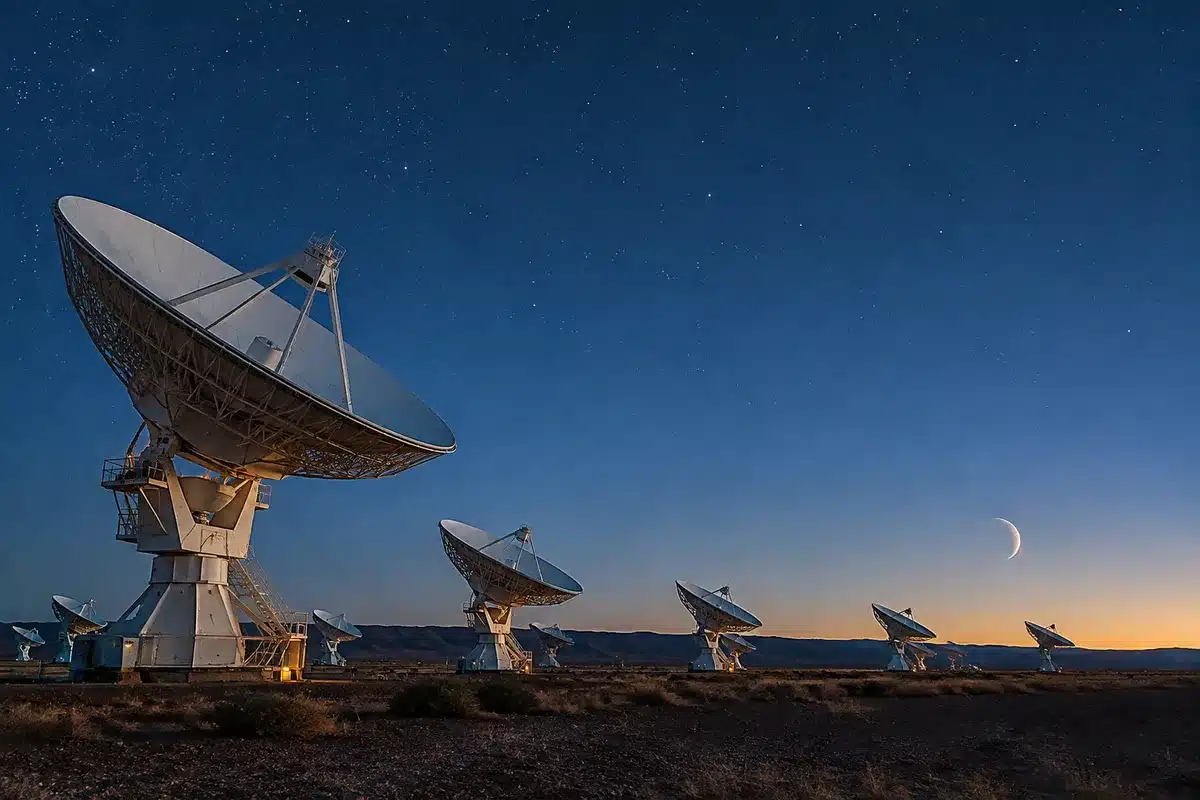
A team led by graduate student Kevin Ortiz Ceballos used South Africa’s MeerKAT radio array to observe the giant exoplanet Beta Pictoris b, a world about 64 light-years from Earth with roughly ten times Jupiter’s mass. Observers recorded short, repeating bursts of radio waves coming from the system.
Ultra-thin women smoking cigarettes are making a comeback as a fashion trend
Windows Memory Diagnostic explained: what the test does and how to read results

At first the origin was uncertain: the bursts could have come from Beta Pictoris, the host star, rather than the planet. To resolve that, researchers compared the radio source positions with distant background quasars, which serve as fixed reference points on the sky. That comparison showed the bursts aligned with the planet’s location rather than the star’s.
Natural processes, not technosignatures
While searches for extraterrestrial intelligence often look for artificial radio patterns, scientists caution that planets and stars can produce radio emission naturally. Two plausible mechanisms are magnetic reconnection—where a planet’s and star’s magnetic fields interact, especially for very close-in planets—and powerful aurorae driven by charged particles striking the upper atmosphere.
The authors of the preprint favor an auroral interpretation for the Beta Pictoris b bursts. Independent experts not involved in the work described the result as the most convincing direct detection to date of radio emission tied to an exoplanet, emphasizing that the signal does not constitute evidence of alien technology.
Measuring a planet’s magnetic field from afar
From the detected radio properties the team estimated Beta Pictoris b’s magnetic-field strength at about 1,250 gauss. For perspective, Jupiter’s field is roughly 4.3 gauss and Earth’s about 0.5 gauss, according to reporting cited in the study. That makes Beta Pictoris b’s field orders of magnitude stronger than fields in our own solar system.

Magnetic-field measurements matter because a planet’s magnetosphere can help shield its atmosphere from stellar winds and high-energy particles. Scientists say that understanding how magnetospheres are generated and how strong they can become is important for assessing atmospheric retention—and, in the long term, habitability—especially for smaller, rocky worlds.
Researchers note that Beta Pictoris b itself is massive with a thick atmosphere and is not considered a likely host for life. Still, the technique used to detect and localize the radio bursts could be applied to other systems, including smaller exoplanets where magnetic shielding would have greater implications for habitability.
Next steps and future telescopes
The result comes from a preprint that has not yet undergone peer review, and the team’s interpretation remains subject to scrutiny and follow-up observations. MeerKAT is a pathfinder instrument for the much larger Square Kilometre Array, which is expected to become operational in the coming years and will offer substantially greater sensitivity.
With more powerful arrays, astronomers say they will be able to survey many more systems for similar radio phenomena, improving the chances of mapping exoplanet magnetic fields and refining our understanding of planetary environments beyond the solar system.