
Show summary Hide summary
Scientists using a nascent neutrino telescope planted on the Mediterranean seafloor have tested whether a fundamental symmetry of physics holds true—and found no breach. The early data, gathered from a small fraction of the planned array, nonetheless place limits that rival much larger, longer-running experiments.
Putting a basic assumption to the test
The team looked for violations of Lorentz invariance, the principle that physical laws are the same regardless of an observer’s constant motion or orientation. If space-time behaves differently at the smallest scales—as some quantum gravity theories suggest—that invariance could fail, but only by an extremely small amount.
Alexa Home Map provides a visual dashboard to manage smart home devices
Evaluating Fernando Mendoza and Carson Beck after their debut starts
To search for such tiny effects, researchers need particles that travel vast distances and interact very weakly. Enter the neutrino: nearly massless, electrically neutral, and able to pass through Earth with little interference. The KM3NeT/ORCA collaboration used neutrinos to probe whether their oscillations between flavors deviate from standard predictions over long paths.
How ORCA listens to ghostly particles
ORCA, short for Oscillation Research with Cosmics in the Abyss, is part of the broader KM3NeT neutrino telescope. The detector’s units are anchored on the seabed off the coast of Toulon, France. Each unit carries 18 glass spheres, and each sphere holds 31 light sensors that register tiny flashes produced when a neutrino collides with a particle in seawater.

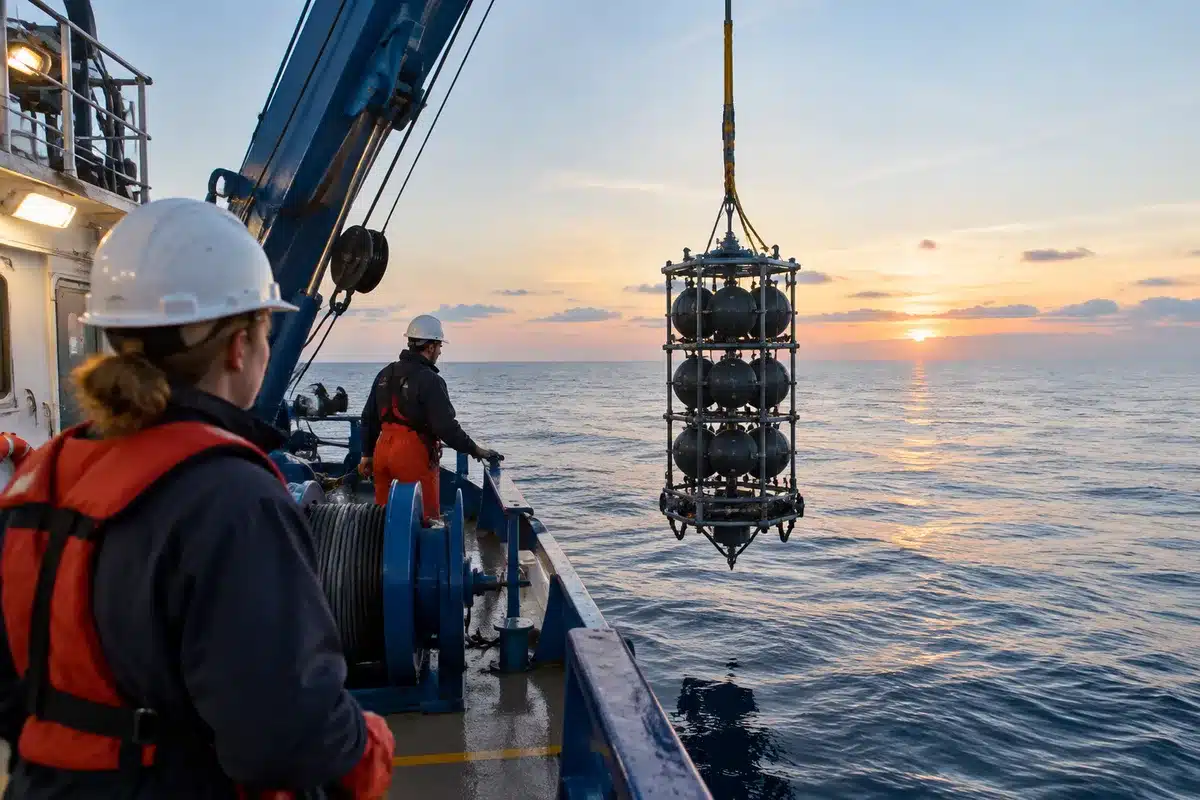
As a doctoral student, Alba Domi helped deploy the first detection units by boarding one of the two ships used during the initial campaign, lowering the modules to about 1.5 miles (2.4 kilometers) beneath the surface. The instrument’s design and the clarity of seawater let ORCA reconstruct the direction and energy of incoming neutrinos with a different set of trade-offs than ice-based detectors.
“Only the neutrinos can get through,” said co-author Lukas Hennig, describing why the team selected particles that traveled upward through Earth. By using Earth itself as a filter, the researchers removed most of the atmospheric particle background and focused on neutrinos that had crossed long distances, in some cases traversing the roughly 7,900-mile (12,700-km) diameter of the planet.
Results from a compact array
The analysis used 5,828 neutrino events recorded over roughly 17 months between 2020 and 2021, collected when the detector consisted of six operational units. The observed oscillations matched the expectations of the Standard Model and general relativity, leaving no evidence of Lorentz-violating effects within the experiment’s sensitivity.

That negative result is still scientifically powerful. The team placed new constraints on possible Lorentz invariance violations, including the first direct limits on a class of violations that would affect muon and tau neutrinos differently. As Hennig put it, if a theoretical model predicts a Lorentz violation stronger than these limits, “the data rule it out. In that case, you can be pretty sure that this model is not correct.”
Competitive limits from a small instrument
Although the measurement relied on a fraction of KM3NeT/ORCA’s eventual size, its bounds on several key parameters are competitive with those from Japan’s Super-Kamiokande—which required 12 years of data—and IceCube, which used two years of data from its full Antarctic array. The authors say they were surprised by how strong the constraints already are given only six detection units in the water.
Deployment has continued since those observations. The collaboration reports 44 units now submerged, and plans call for activating 108 units by 2030 to improve sensitivity further.
Next steps: wider reach and higher energies
Because possible Lorentz-violating signals grow with distance and energy, the best prospects lie with neutrinos that travel farther and carry more energy. The team intends to extend the search using KM3NeT’s ARCA detector, located off Sicily, which is optimized for high-energy cosmic neutrinos arriving from distant astrophysical sources.
“If space-time does have a grain,” Domi said, “those particles may be among the first to feel it.”
Study citation: Adriani et al. (2026). Atmospheric neutrino constraints on Lorentz invariance violation with the first six detection units of KM3NET/ORCA. Journal of Cosmology and Astroparticle Physics. https://doi.org/10.1088/1475-7516/2026/11/012