Show summary Hide summary
Archaeologists working at a Late Antique cemetery in northwestern Germany have identified a rare strain of leprosy in the remains of a high-status man buried in a wooden boat. DNA recovered from his teeth and a foot bone points to a pathogen never before recorded in Central or Northern Europe, and the burial goods suggest far-reaching connections across the Roman world.
The burial and its objects
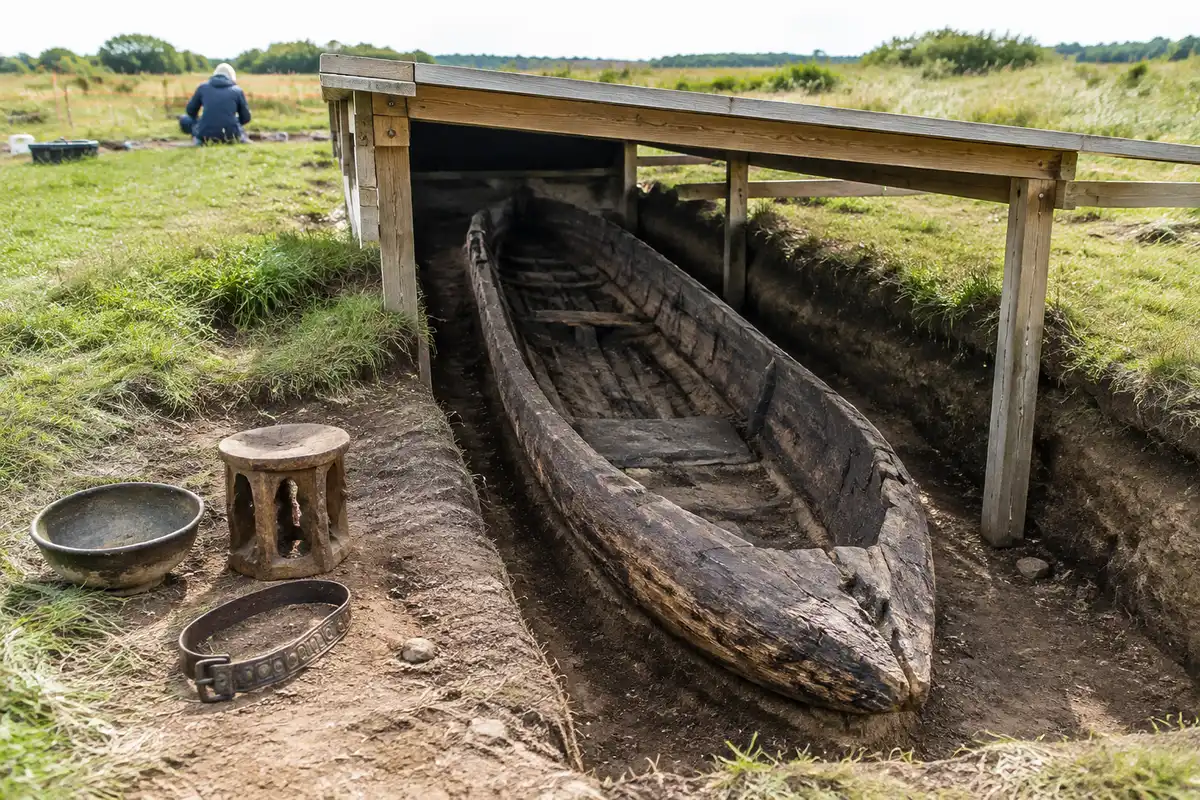
The man was interred in an oak boat roughly 4 meters long, capped by a roof-like covering. He was about 50 years old at death, dated to between A.D. 425 and 450, and his grave included striking items: a small water-bird–shaped box, a bronze basin, a carved maple stool with a hunting scene and runic inscription, and an alder chair that resembles a throne.
Alexa Home Map provides a visual dashboard to manage smart home devices
Evaluating Fernando Mendoza and Carson Beck after their debut starts

Researchers note the presence of a late Roman military belt among the goods and the man’s well-developed upper-arm bones. Those details point to maritime work immediately before death — perhaps as a fisherman or boatman — and to connections reaching beyond the local region.
“The grave goods placed in the tomb aroused particular scientific interest,” said study co-author Hauke Jöns of the Lower Saxony Institute for Historical Coastal Research, calling the belt evidence of long-distance ties.
A rare strain of leprosy and genetic origins
Scientists sequenced genomes from a dozen people buried at the site of Fallward to investigate origins and health. One individual tested positive for DNA from Mycobacterium leprae, the bacterium that causes leprosy, recovered from a tooth and a foot bone.

Because the pathogen’s genetic material was unusually well preserved, researchers were able to place the infection within a lineage that, according to the study, likely evolved in Egypt between the fourth and second centuries B.C. That specific lineage has not previously been documented in Central or Northern Europe.
Analysis of the man’s human DNA indicated he likely came from the Danube region. “Genetic analyses confirm that a man buried at Fallward originated from the Danube region,” said the study’s first author, Daniel Myburgh of Kiel University’s Institute of Clinical Molecular Biology (IKMB).
Signs of disease — and what they mean
Despite the genomic evidence, the skeleton showed no classic bone lesions of advanced leprosy. The disease initially affects nerves and soft tissues, and only later can it damage bone, especially in the face, hands and feet.
“Either he was affected by an asymptomatic form of the disease, or the disease had so far only affected soft tissues,” said co-author Almut Nebel, a biologist at IKMB. The preservation of bacterial DNA, she added, suggests he may have traveled widely while carrying the infection.
Mobility and social status after Rome
Researchers propose several scenarios that would explain the combination of foreign origin, Roman military equipment and high-status burial. One possibility, noted by study co-author Ben Krause‑Kyora, is that the man might have been a Roman-era mercenary who later settled between the Elbe and Weser rivers.
Alternatively, the Roman belt could have arrived through trade, inheritance or as a trophy of conflict. In any case, the find reinforces that communities in northwest Germany maintained long-distance links even after the collapse of centralized Roman authority.
Study: Myburgh, D. A., da Silva, N. A., Romeyer-Dherbey, J. H., Grefen-Peters, S., Jöns, H., Peek, C., Nebel, A., & Krause‑Kyora, B. (2026). Paleogenomics reveals leprosy at the late antique burial site of Fallward in northern Germany. iScience, 29(11), 117877. https://doi.org/10.1016/j.isci.2026.117877