
Show summary Hide summary
While digging in a Roman-period cemetery near Wrocław, archaeologists uncovered a far older burial: the skeleton of an adult male placed with a tooth necklace, two human skulls and a stone battle ax. The find, dated to the Middle Neolithic by the style of the ax, offers a rare glimpse into funerary practices nearly 5,000 years ago.
A surprise under later layers
The team had been working in a cemetery used in Roman times when they noticed an unusual circular feature in the soil. Excavators opened the feature and revealed a nearly complete adult male skeleton surrounded by grave goods that did not match the Roman context.
Ultra-thin women smoking cigarettes are making a comeback as a fashion trend
Windows Memory Diagnostic explained: what the test does and how to read results
Paweł Dąbrowski, a biological anthropologist at Wrocław Medical University, said the discovery came late in the field season. According to a translated statement issued Sept. 2, the excavators found what appeared to be a deliberately arranged string of animal teeth.
Tools, beads and a tooth necklace
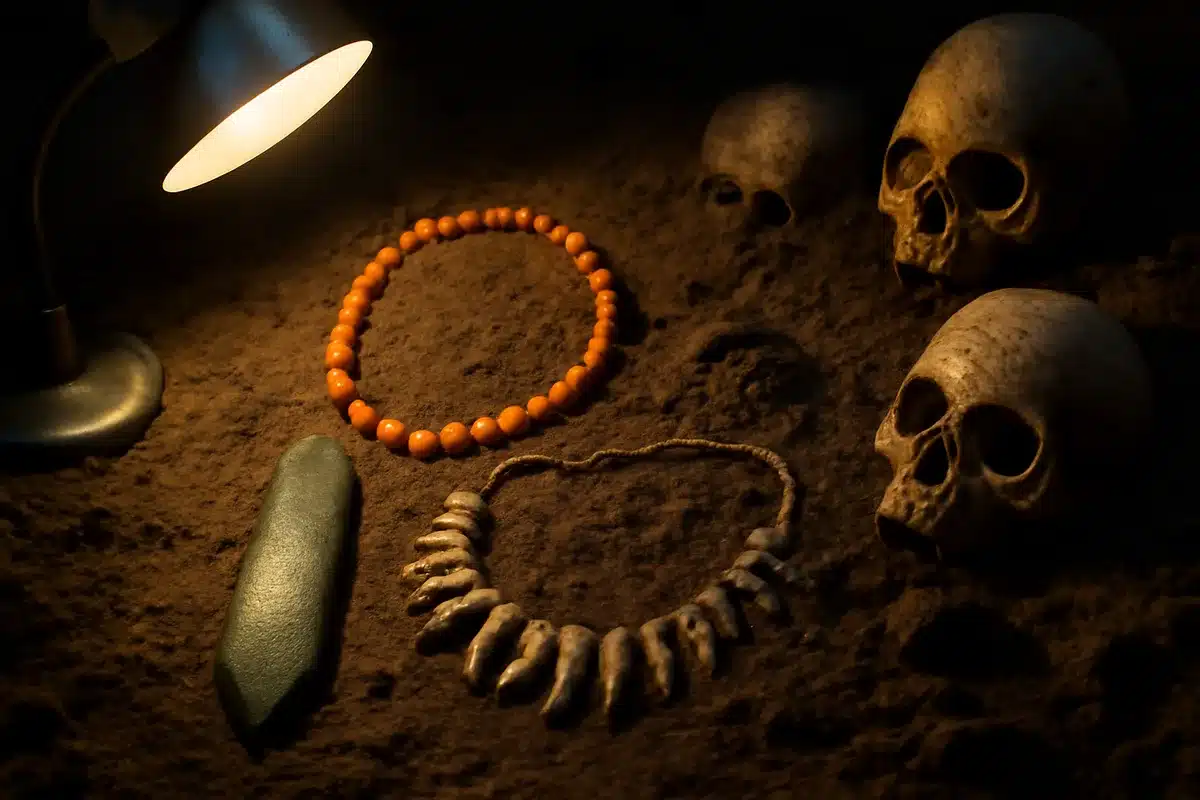
Buried with the man were amber beads, a flint blade and a battle ax made of serpentinite. The ax’s form and material point to a Neolithic date — about 2900 B.C., specialists say — placing the burial in the Middle Neolithic rather than the Roman era above it.
- Amber beads and flint blade
- Serpentinite battle ax, found beneath the right elbow
- A necklace composed of 42 drilled teeth
- Two additional human skulls deposited in the grave
Dąbrowski noted in a Sept. 4 translated statement that the 42 teeth were arranged with care and each showed a hole drilled through the root, consistent with their having been strung as a necklace. The teeth include incisors and canines from large mammals — wolves, deer and bears — and may even include human teeth.
Skulls, rituals and unanswered questions
Archaeologists also recovered two human skulls near the burial. The team proposes these could represent decapitated heads placed as offerings, but they emphasize that further analysis is required to confirm whether the skulls were decapitated or deposited in another manner.
Because some elements of the ensemble — high-value items and a tooth necklace — suggest status, Dąbrowski said the grave could belong to an important individual, perhaps a hunter or a clan leader. He and colleagues are careful, however, not to overinterpret the evidence before laboratory work is complete.
Local parallels and next steps
Researchers point out a comparable high-status Neolithic burial found nearby, which included axes, flint tools, amber beads and the bones of a calf, interpreted as possible sacrificial offerings. To date, these two burials remain the only examples of this specific assemblage in the area.
The team believes both graves may be linked to the Corded Ware culture, a widespread Neolithic phenomenon that researchers associate with the dispersal of Indo-European languages across Europe and parts of Asia. Scientists now plan genetic and isotopic analyses to determine whether the individuals were related and to reconstruct aspects of their diet and mobility.
Dąbrowski said the first results from those studies are expected later this year, a step he described as essential for understanding who these people were and how they lived nearly five millennia ago.