Show summary Hide summary
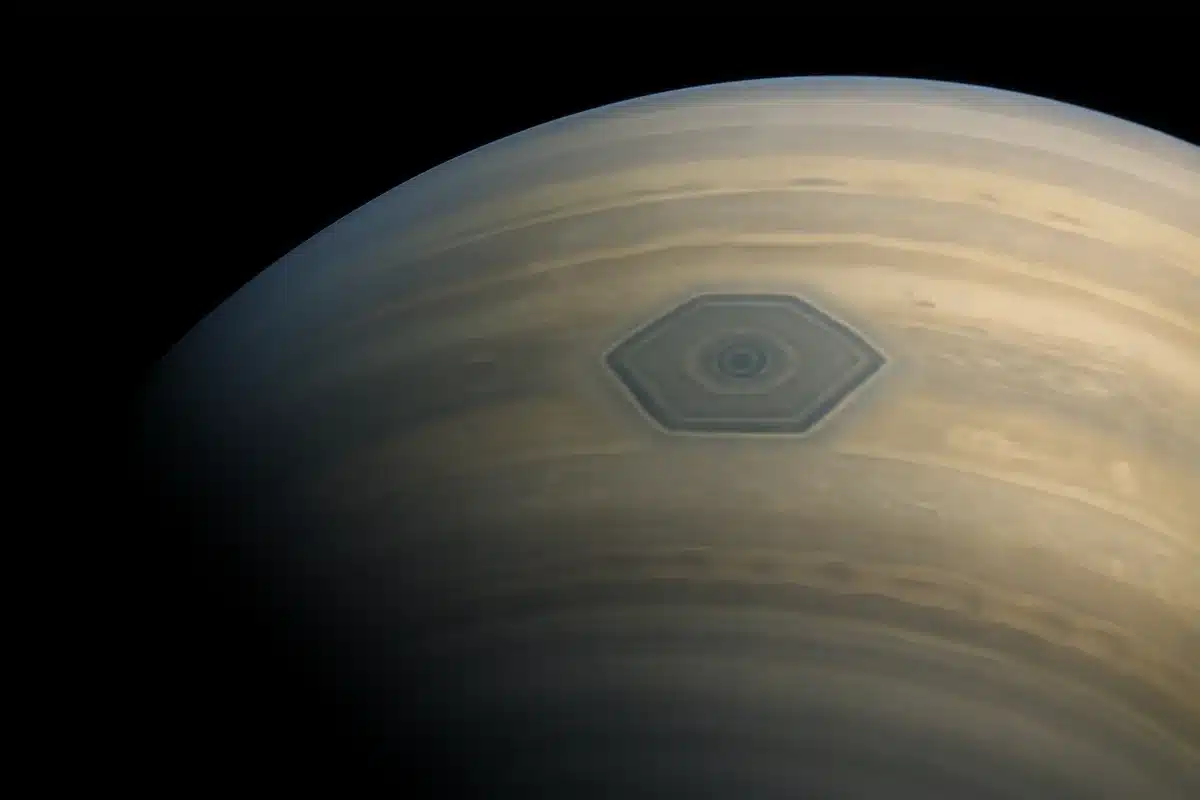
New Hubble images reveal a striking ten-sided atmospheric pattern encircling Saturn’s south pole — a geometric wave that appears to have formed only recently. Scientists say the feature offers a rare chance to observe a large-scale atmospheric structure grow in real time, and they are racing to understand how it arose so quickly.
Hubble captures a growing “decagon”
The Hubble Space Telescope recorded high-resolution views of the phenomenon, which archival data indicate began to take shape in 2023. The structure resembles a ten-sided wave — a decagon — sitting within a broad jet stream around Saturn’s south pole and visible through multiple atmospheric layers.
Ultra-thin women smoking cigarettes are making a comeback as a fashion trend
Windows Memory Diagnostic explained: what the test does and how to read results

Because the wave shows up at different altitudes, researchers conclude it is not confined to the visible cloud tops. That vertical reach suggests the disturbance is a deep, coherent pattern in Saturn’s atmosphere rather than a short-lived surface feature.
How astronomers discovered it
Ground-based observers first reported an unusual undulating band around Saturn’s south pole in 2024. The initial identification came from work by Agustín Sánchez-Lavega, amateur astronomers Trevor Barry and Jean-Paul Oger, and data aggregated through the University of the Basque Country’s Planetary Virtual Observatory Laboratory.
Hubble’s follow-up imaging formed part of its Outer Planet Atmospheres Legacy program, which takes annual snapshots of the solar system’s gas giants to track long-term atmospheric change. The Cassini spacecraft, which studied Saturn from 2004 to 2017, did not record this feature — implying it developed after that mission ended.
“The question is, why did it suddenly form now when we haven’t seen one before?” said Amy Simon, a senior scientist at NASA’s Goddard Space Flight Center and a co-author of the new study describing the observations.
Why the discovery is surprising
Planetary scientists are struck by the speed and timing of the decagon’s appearance. Saturn’s well-known northern hexagon has been a persistent feature for decades, so finding a transient, ten-sided counterpart at the opposite pole challenges assumptions about the planet’s atmospheric symmetry and stability.
“The northern hexagon has been there every time we’ve looked for more than 40 years,” Simon added. That long-lived pattern contrasts with the south-pole wave, which seems to be intensifying as astronomers watch.
What researchers hope to learn next
Authors of the study, published in Science Advances (Sánchez-Lavega et al., 2026), emphasize the need for continued monitoring. Observations from Hubble combined with planned studies using the James Webb Space Telescope (JWST) will help determine how the wave is generated and whether it will stabilize into a persistent structure or dissipate.

Sánchez-Lavega noted that, given Saturn’s north–south jet stream symmetry, researchers have searched Hubble archives for a southern counterpart since 1990. The absence of a similar feature in earlier data, and in Cassini’s records, points to a recent emergence rather than a long-hidden pattern.
Broader context in the solar system
Polar atmospheric oddities are not unique to Saturn. The article notes that NASA’s Juno mission revealed an array of large, oval cyclones at Jupiter’s south pole in 2017 — another example of complex polar dynamics on a gas giant. Comparing these phenomena can help scientists refine models of planetary weather and large-scale atmospheric waves.
For now, the developing decagon presents an uncommon observational opportunity. With Hubble and JWST set to revisit Saturn, researchers expect new data to clarify the wave’s origins and what it reveals about the physics of giant-planet atmospheres.