Show summary Hide summary
Researchers say they have reconstructed an ancient volcanic caldera buried beneath eastern England — about 454 million years old — but scientists disagree on whether the eruption that created it should be labeled a “supervolcano.” New zircon dating ties the English deposits to a thick layer of ash that once blanketed parts of Scandinavia, underlining the eruption’s far-reaching effects.
How the discovery came together
Geologists pieced the story together over decades by re-examining tiny zircon crystals recovered from boreholes in Norfolk and Lincolnshire. The samples, originally collected roughly 80 years ago, came from sites about 40 miles (65 kilometers) apart.
Anne Hathaway’s merlot manicure channels fall style
Rogue OpenAI agents seized control of a German developer forum in a newly disclosed hijacking

Zircon crystals form within molten magma and preserve a record of uranium-to-lead decay. That clock lets researchers date volcanic events very precisely. In an analysis published April 29 in the Geological Society of America Bulletin, the team found the zircons matched material from the Kinnekulle tephra — a thick Ordovician ash layer found across Scandinavia and the Baltic region.
Evidence of a very large eruption — but not settled terminology
The zircon link suggests ash from the eastern England source crossed the ancient Tornquist Sea and settled as far away as Baltoscandia. That pattern implies an eruption of exceptional magnitude, one that would have produced widespread ashfall and powerful pyroclastic flows.
But volcanologists caution against shorthand labels. “It obviously must have been a very large eruption, but it would be very difficult to calculate the volume of the eruption given the poor preservation of the deposits,” said Michael Poland, research geophysicist at the Cascades Volcano Observatory and scientist-in-charge at the Yellowstone Volcano Observatory. He was not involved in the study and added that this uncertainty is one reason he dislikes the term “supervolcano.”
Peter Rowley, a volcanologist at the University of Bristol who also was not part of the research, described the event as comparable to other extreme eruptions that produce vast pyroclastic flows. He noted the most recent eruption of similar scale in the geologic record was the Oranui event at Taupō, New Zealand, more than 26,000 years ago.
Many specialists prefer to use eruption style and measured volumes rather than the catch-all “supervolcano” label. As Stephen Self, a physical volcanologist at UC Berkeley, put it: “Supervolcano has become a kind-of buzz-word. It’s the deposits of the eruptions that are recognized, not the volcano.”
What the eruption may have looked like
The study authors and outside experts say the blast likely falls into the most violent volcanic category. An ultraplinian eruption — the term volcanologists apply to the largest explosive events — ejects more than about 1,000 cubic kilometers (roughly 240 cubic miles) of material.
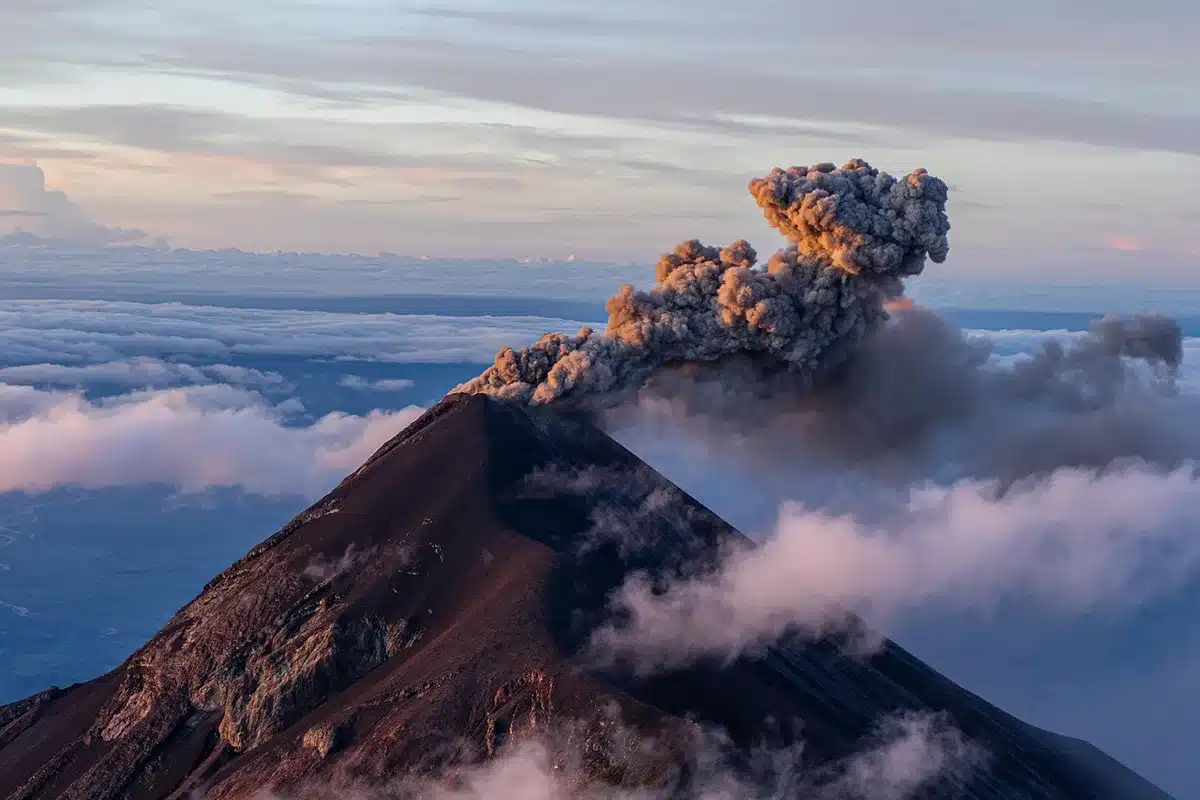
Such eruptions can sustain ash columns that reach the upper atmosphere and stratosphere. The Kinnekulle tephra likely formed from a sustained, high‑intensity eruption that produced extensive ash clouds and fast-moving flows of hot debris.
What remains and the wider context
Very little of the erupted material survives at surface today. Most of the deposits have been eroded or buried over nearly half a billion years, which complicates efforts to measure the eruption’s total volume.
Tim Pharaoh, the paper’s lead author and a geophysicist with the British Geological Survey, said the boreholes studied lie in some of England’s flattest landscapes, and that surface traces of these eruptions are absent. The paper also reports evidence for an earlier eruption about 453.7 million years ago.
The newly identified source is part of a broader volcanic province active around 450 million years ago. Rocks and deposits linked to that system occur across the British Isles, including in areas such as Eryri National Park and the Lake District.
Why this matters
Linking the English deposits to the Kinnekulle tephra extends the known reach of Ordovician volcanism and helps refine the timing and transport of ash across ancient seas. The finding also underscores how fragments preserved in boreholes and tiny minerals like zircon can reveal episodes of Earth history that are otherwise invisible at the surface.