Show summary Hide summary
A large, well-preserved base camp unearthed in interior Alaska is rewriting parts of the continent’s early history. Excavations at Shégˊ Xdaltthˊíˊ — a site dated to about 13,800 years ago — have produced thousands of artifacts, the oldest known dwelling evidence in the Western Hemisphere and remains that may represent some of the earliest domesticated dogs in the Americas.
A rare Beringian base camp
Shégˊ Xdaltthˊíˊ, whose name means “They Were There” in an Alaska Native Athabascan language, lies roughly 34 miles southeast of Fairbanks. Archaeologists say the location served as a recurring camp for people who occupied the area intermittently for up to a thousand years.
Rugged phone’s camera detaches to double as an action cam
Burger King turns to local franchisees to jump-start its U.S. comeback
Field teams documented a hearth, a small pit and a discoloration in the soil where a wooden post once stood — features consistent with a lean-to or early tent house. Nearby they found an earth oven filled with charcoal and animal bone, suggesting slow-cooking for a sizeable group. The combination of structural traces and dense artifact scatters led researchers to describe the discovery as the earliest potential habitation structure in North America.
Tools and threads: cultural links across continents
The artifact assemblage at the site is striking in both size and diversity. Excavators recovered tens of thousands of items, including stone tools made from rhyolite and basalt, a pendant carved from antler, and multiple fragments of bone needles.

Some of the stone implements — called diamond-shaped hafted bifaces — resemble tools typically recovered much farther west in Beringia, in what is now northern Siberia. Obsidian pieces found at the camp point to a volcanic source located hundreds of miles northwest of the site. Taken together, these materials indicate long-distance connections or exchanges between early Alaskans and groups across the Bering Land Bridge.
The bone needles are especially notable. The team recovered eight fragments of eyed needles, which are the oldest such sewing tools recorded anywhere in the Western Hemisphere. Similar sewing implements had previously been documented only at Paleoindian sites farther south, so their presence at Shégˊ Xdaltthˊíˊ suggests cultural links between early Alaskans and contemporaneous communities below the ice sheets.
Canids at the camp: early dogs or wild wolves?
Faunal remains at the site include bones from more than a dozen wolf-like animals. Analysis of a jaw from one specimen shows it does not match dire wolves or the Pleistocene Beringian and gray wolves commonly identified in the region. Instead, the researchers describe a population of wolf-like canids unique to central Alaska.
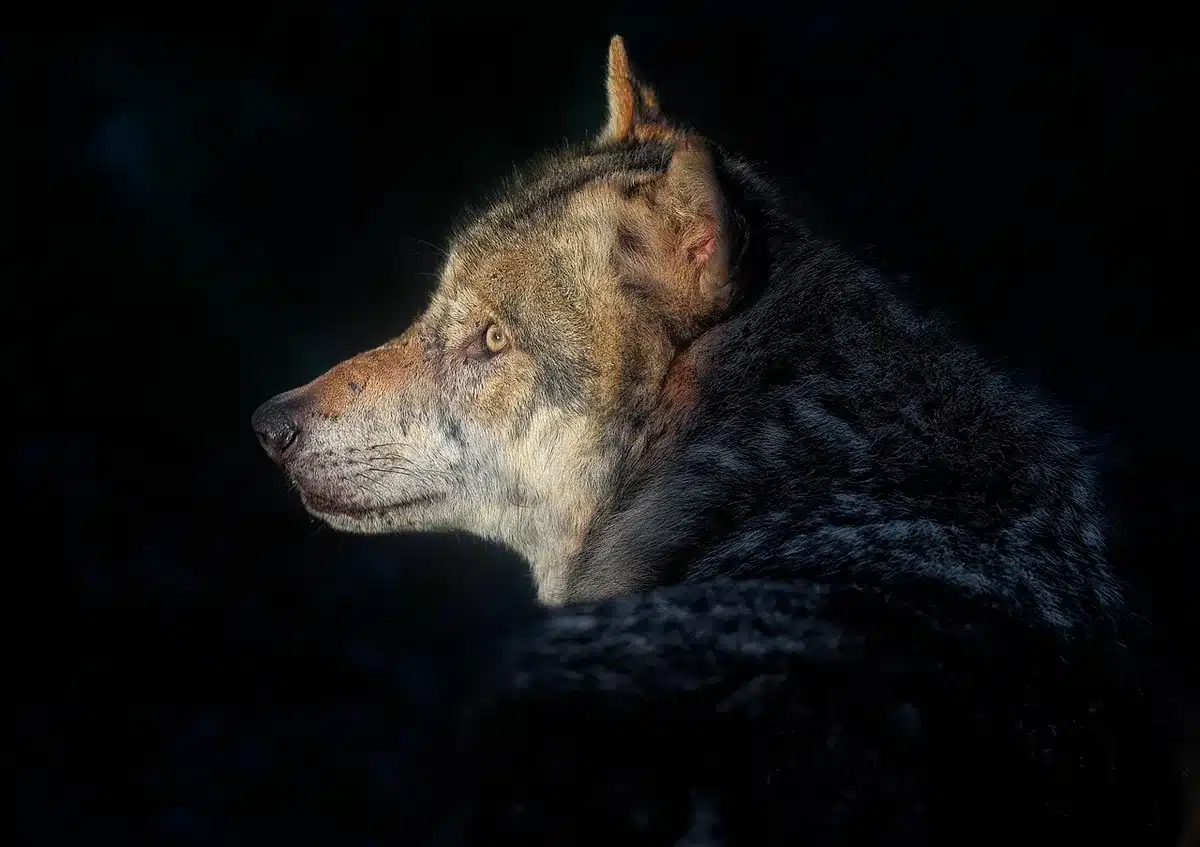
Current genetic evidence indicates that the first domesticated dogs in North America trace their ancestry to Siberian wolves. Given the timing and geographical position of Shégˊ Xdaltthˊíˊ, the researchers say the assemblage provides circumstantial evidence that people at the site may have had close relationships with canids — possibly early domesticated dogs — though the team stops short of a definitive claim.
“Like humans, potentially, the canids of Shégˊ Xdaltthˊíˊ and other early Alaskan sites were recent immigrants from Asian Beringia,” the study authors wrote.
Context for the peopling of the Americas
The site sits in eastern Beringia, the landmass that once connected northeast Asia and northwest North America during the last ice age. Recent archaeological and genetic work suggests the ancestors of today’s Indigenous Americans entered the continent roughly 21,000 years ago, but many questions remain about how and when people established more permanent settlements.
Researchers note that Shégˊ Xdaltthˊíˊ is one of the few places in Beringia yielding a large, well-preserved record of prolonged occupation. The study’s perspective author, archaeologist Spencer Pelton of the University of Wyoming, wrote that the site offers an “unprecedented glimpse” into the lives of North America’s early residents.
What the discovery changes — and what remains unknown
The assemblage links Beringian populations with both Asian groups to the west and early American communities to the south. Yet it does not resolve whether those ties reflect regular seasonal travel or broader networks of exchange. “It would be hard to pin down whether or not they were moving back and forth during a lifetime,” said study lead author Kelly Graf of the University of Kansas, who called the scale of the find a surprise.
Graf and colleagues published their findings Oct. 14 in the journal Science Advances (DOI: 10.1126/sciadv.aeh0802). The team includes Alaska Native elders as co-authors; elders helped name the site and advised where to excavate.
Further work in Beringia is needed
Archaeologists plan more field seasons at Shégˊ Xdaltthˊíˊ and in surrounding parts of Alaska. The region is vast and underexplored, and the authors say further digging could clarify whether humans were settling in Beringia significantly earlier than the 13,800-year occupation documented here.
Only a small number of older sites — such as the roughly 24,000-year-old Bluefish Caves in the Yukon — currently suggest people lived in Beringia far earlier. More targeted research could help map migration routes, cultural contacts and the timing of human and animal movements across the ancient land bridge.