
Show summary Hide summary
Allison and Stephen Ellsworth, the entrepreneurs behind Poppi, are entering the crowded hydration market with Jetty, a line of electrolyte drinks and mix-in packets. The brand is designed for everyday use rather than intense workouts, putting it in competition with Gatorade and newer hydration products.
A lower-electrolyte pitch for daily use
Jetty is sold at Whole Foods and online through Target and Amazon. The Ellsworths are funding the venture themselves, setting up a new challenge against PepsiCo, which acquired Poppi for $1.95 billion in 2025 and also owns Gatorade.

Gatorade holds about 60% of the U.S. sports drink market, according to Numerator data. Jetty is taking a different approach: its founders say it is meant for people who want more flavor and electrolytes than plain water, but not necessarily the sugar or electrolyte levels associated with traditional sports drinks.
Poppi’s founders take a new beverage venture, Jetty, into Gatorade’s market
Blueprint and Lucky Red team up for English-language remake of German comedy «No Hit Wonder»
That positioning reflects a broader shift in how beverage companies talk about hydration. Sports drinks have long been marketed around exercise and recovery, even as many people consume them in everyday settings. Jetty is targeting that routine use directly.
“No one has really created a product for just everyday hydration — literally everyday hydration for normal people,” Allison Ellsworth, the brand’s chief brand officer, told CNBC. “Like I woke up this morning, I didn’t run a marathon.”
How GLP-1 use influenced the idea
After the Poppi sale, Ellsworth remained an adviser to the company but stepped away from its daily operations. She has said that, after a decade spent building Poppi, she had more time to focus on her health. She began taking a GLP-1 medication and lost 60 pounds.

Her husband, Stephen Ellsworth, who is Jetty’s CEO, noticed that she was not drinking enough, including after going to the gym. Allison Ellsworth said she found it physically difficult to consume enough liquid.
GLP-1 medications such as Ozempic and Mounjaro can reduce thirst. Hydration may also help ease some side effects, including nausea and headaches, making the issue relevant to some people taking the drugs.
Jetty’s founders see flavored beverages as one option for people who find water unappealing. In an EY-Parthenon survey of more than 3,600 current or former GLP-1 users, about 44% said they were consuming more functional beverages.
The company is also seeking customers beyond that group. Ellsworth has identified millennial mothers and Gen Z consumers as core audiences, arguing that younger shoppers may not connect with long-established sports drink brands.
Hydration products draw more competitors
Demand for hydration and electrolyte products has been rising. Dollar sales in the category increased 20% to $2.6 billion in the 52 weeks ended Oct. 4, according to SPINS data. The data provider reported a repeat-purchase rate of 62%.
Large beverage companies are expanding their own offerings. Kraft Heinz introduced Capri Sun pouches and Kool-Aid packets with electrolytes. Pepsi has also updated Gatorade’s positioning to include occasions such as a morning start or an afternoon walk. Electrolit, distributed by Keurig Dr Pepper, recorded 40% retail sales growth in the company’s third quarter.
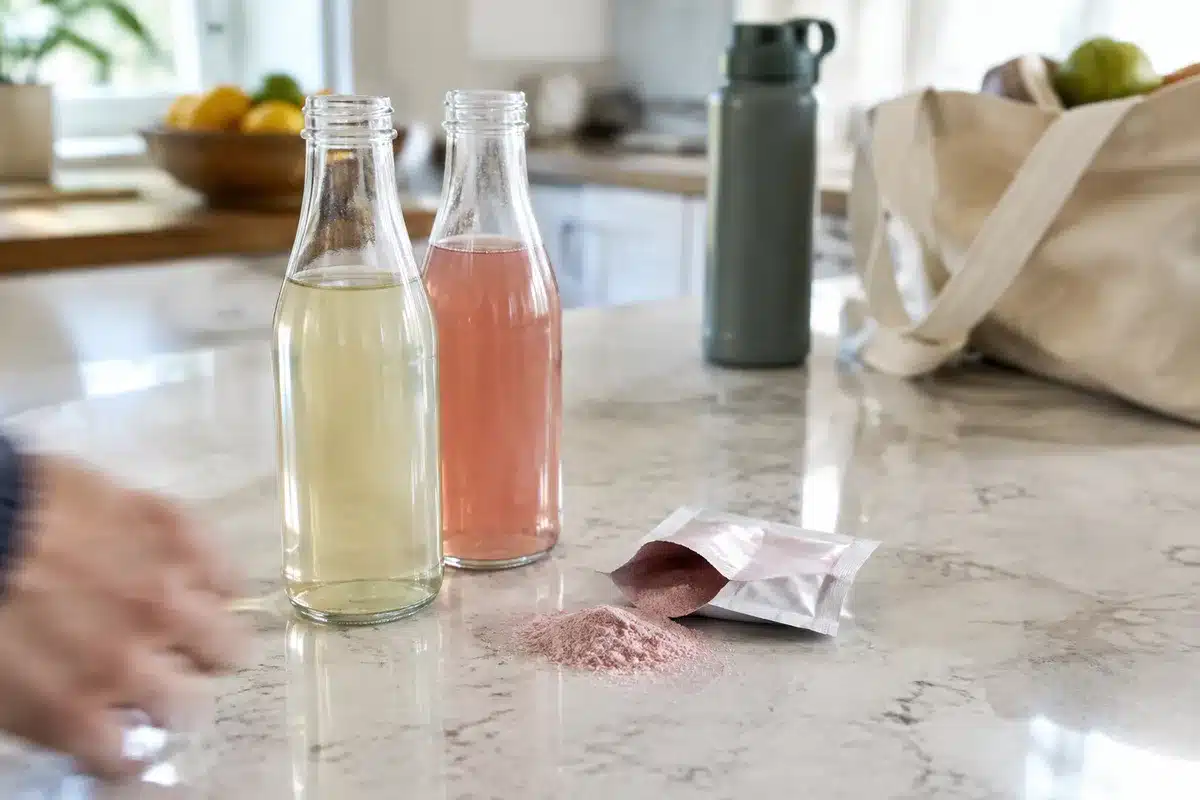
Jetty plans to sell both bottled drinks and powdered mixes. The two formats offer different routes to shoppers, as brands compete for shelf space and a larger share of beverage purchases.
Single-serving electrolyte powders are growing faster than ready-to-drink products, Ellsworth said, citing brands such as Unilever’s Liquid I.V. and LMNT. She estimated that electrolyte powders represent a $1 billion category on Amazon alone.
The broader ready-to-drink sports drink market is larger, but it faces pressure. Numerator data show unit sales declined 9.1% from 2022 to 2026 as consumers turned to other hydration options. Coca-Cola has also written down BodyArmor’s value by more than $1.7 billion after taking control of the brand for $5.6 billion in late 2021.
What Jetty contains
Jetty is launching with five flavors: watermelon, orange mango, fruit punch, black raspberry and white cherry. Each 15.2-ounce bottle or 15-gram packet contains 100 milligrams of sodium, 310 milligrams of potassium and 100 milligrams of magnesium.
The products also include B vitamins, 3 grams of fiber and 6 grams of sugar. The founders say Jetty does not use artificial sweeteners or dyes.
By comparison, a 20-ounce bottle of Gatorade Thirst Quencher contains about 270 milligrams of sodium, 80 milligrams of potassium and 34 grams of sugar. Gatorade is also phasing out artificial colors and promoting lower-sugar products.
Lessons from Poppi and a plan to grow
Ellsworth believes Pepsi’s changes to Gatorade may not be enough to win younger consumers, and has criticized the company’s marketing approach. Poppi’s performance under PepsiCo has also been weaker than expected, though the Ellsworths declined to comment on a regulatory filing related to the acquisition.
In October, PepsiCo reported that it estimated the fair value of potential performance-based payments to Poppi’s former owners at $12 million. The deal had included the possibility of an additional $300 million payment if Poppi met certain targets by the third quarter of 2027.
The founders say they are applying lessons from Poppi to Jetty, including a more cautious approach to product claims. Ellsworth said three different claims lawyers reviewed Jetty’s packaging. Poppi previously paid $8.9 million to settle a class-action lawsuit alleging false advertising tied to its “gut healthy” claims.
Jetty has $2.5 million in self-funding, and Ellsworth said the company may seek outside investment in 2027. She said she would favor investors who can provide strategic connections, including access to celebrities, rather than choosing solely on the size of a potential investment.
The brand is also developing a lemon-lime flavor, a classic in the sports drink category. Ellsworth said the founders chose to begin with flavors they personally liked and wanted to ensure the products tasted good.