
Show summary Hide summary
A new analysis shows that so-called white dwarf stars can display a surprising range of visible hues — from chartreuse green to deep salmon pink — rather than the plain white or pale blue their name implies. The findings, based on spectral modelling, suggest these compact stellar cores can look markedly different depending on their composition and atmospheric conditions.
A wider palette than expected
White dwarfs are the cooling cores left behind when low- and medium-mass stars exhaust their nuclear fuel. Despite the name, the study finds many of these remnants would appear in distinct colors if seen up close.
Burger King turns to local franchisees to jump-start its U.S. comeback
Do you want a rewritten headline for each of the listed items, or a single new headline covering the whole list?

The team points to two key physical factors. Cooler white dwarfs can reach densities of about 1 gram per cubic centimeter — similar to water — and are millions of times denser than the sun’s visible surface. At those extreme densities, trace elements interact with a dense helium plasma and absorb light across broader wavelength ranges than they would under lower-density conditions. That shifts a star’s color away from the simple orange, white or blue expected for a near-perfect radiator.
“Most stars, including most white dwarfs, behave like ‘perfect radiators,’ so their colour is set almost entirely by temperature. But nobody had really looked into what else might be possible for white dwarfs,” said Mark Hollands, an astronomer at the University of Warwick and the study’s lead author.
Which chemistry produces which color?
The researchers connected specific spectral signatures to likely visible colors. Their analysis associates certain surface chemistries with characteristic hues:
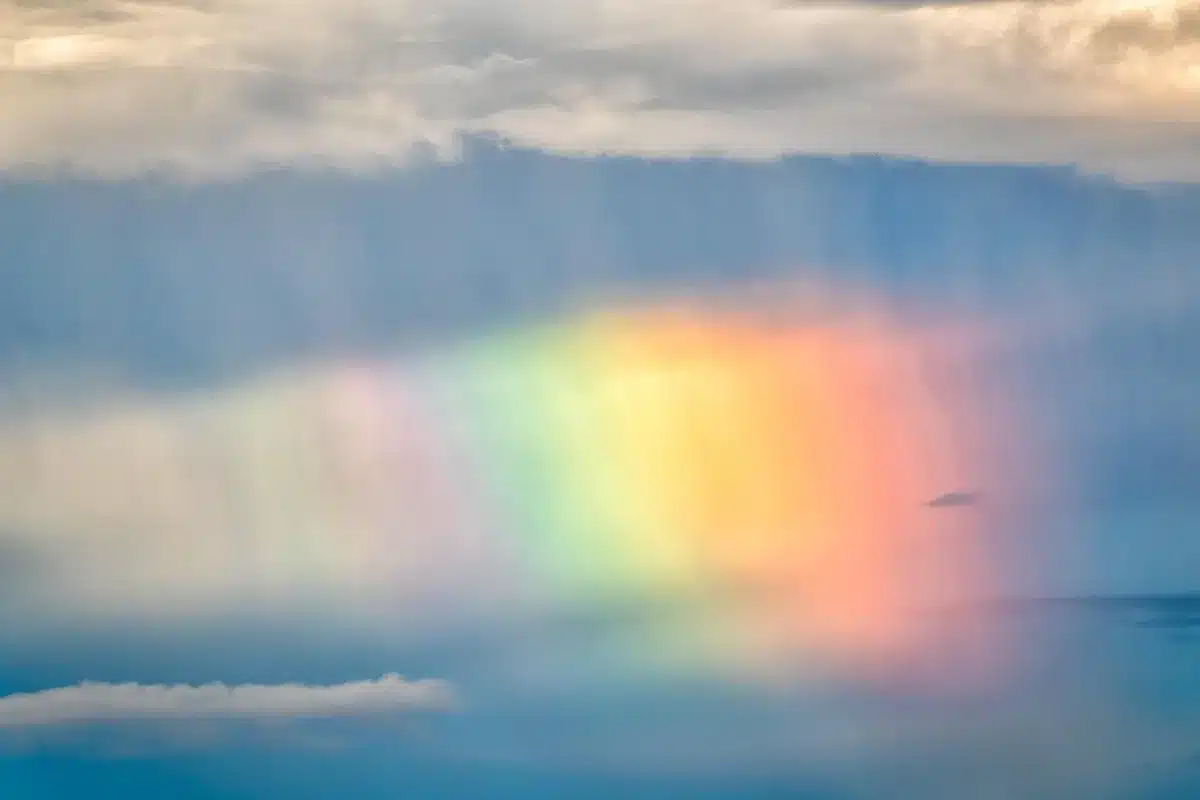
- Carbon-rich atmospheres tend to produce purple or pink tones.
- Debris from rocky bodies, like asteroids or comets, often leads to yellower appearances.
- Dense interactions between hydrogen and helium can yield cyan or pale-blue shades.
Notable discoveries in the sample
Among 151 white dwarfs examined within 65 light-years of Earth, roughly one in 30 would appear in a color other than white. That ratio implies there may be many more colorful stellar remnants in the local neighborhood than previously recognized.
The team highlighted two standout examples. One, designated WD J1330+6435, contains rocky material and shows a chartreuse-green tint. According to the authors, additional calcium, lithium and sodium in its atmosphere absorb orange wavelengths, producing a green appearance. Hollands called the object striking and said its look “feels like something out of science fiction.”
The other unusual case, WD J1011+2845, lies at about 48 light-years from Earth and is described as likely the reddest white dwarf yet found. Strong convection brings carbon from the interior toward the surface. Those carbon molecules obscure other wavelengths and give the star a “deep salmon-pink glow,” the researchers report.
“The traces of sodium in the atmosphere of this white dwarf absorb the orange part of the spectrum, leaving behind a ghostly green glow,” Hollands added in the team’s statement.
How scientists revealed the colors
Because white dwarfs are small and distant, direct color photographs are not feasible for most objects. The researchers instead inferred visible hues by converting each star’s spectral fingerprint into a model of human color perception. This method maps the light distribution across wavelengths into RGB-like values that represent how a person would see the star’s color.
The results are reported in a paper led by Hollands, with co-authors Boris T. Gänsick, Pier-Emmanuel Tremblay and Detlev Koester, published Oct. 15 in RAS Techniques and Instruments (DOI: 10.1093/rasti/rzag069).
What this means for astronomy
Beyond an intriguing visual surprise, the study demonstrates how surface composition and atmospheric density can meaningfully alter the observable properties of stellar remnants. For observers, spectra remain essential not only for chemical analysis but also for predicting how these compact stars would actually look to the human eye.
Researchers say the findings do not overturn temperature-based expectations for most white dwarfs, but they add nuance: under the right conditions, these dense stars can produce uncommon and vivid colors.