
Show summary Hide summary
New analysis of a Neanderthal burial from Shanidar Cave in Iraq suggests the individual was killed by a wooden spear that pierced the chest roughly 75,000 years ago. The study, published in Scientific Reports, argues the wound pattern and force needed point to a high-velocity, life-ending thrust rather than post-mortem damage.
A hole in the shoulder blade points to a violent death
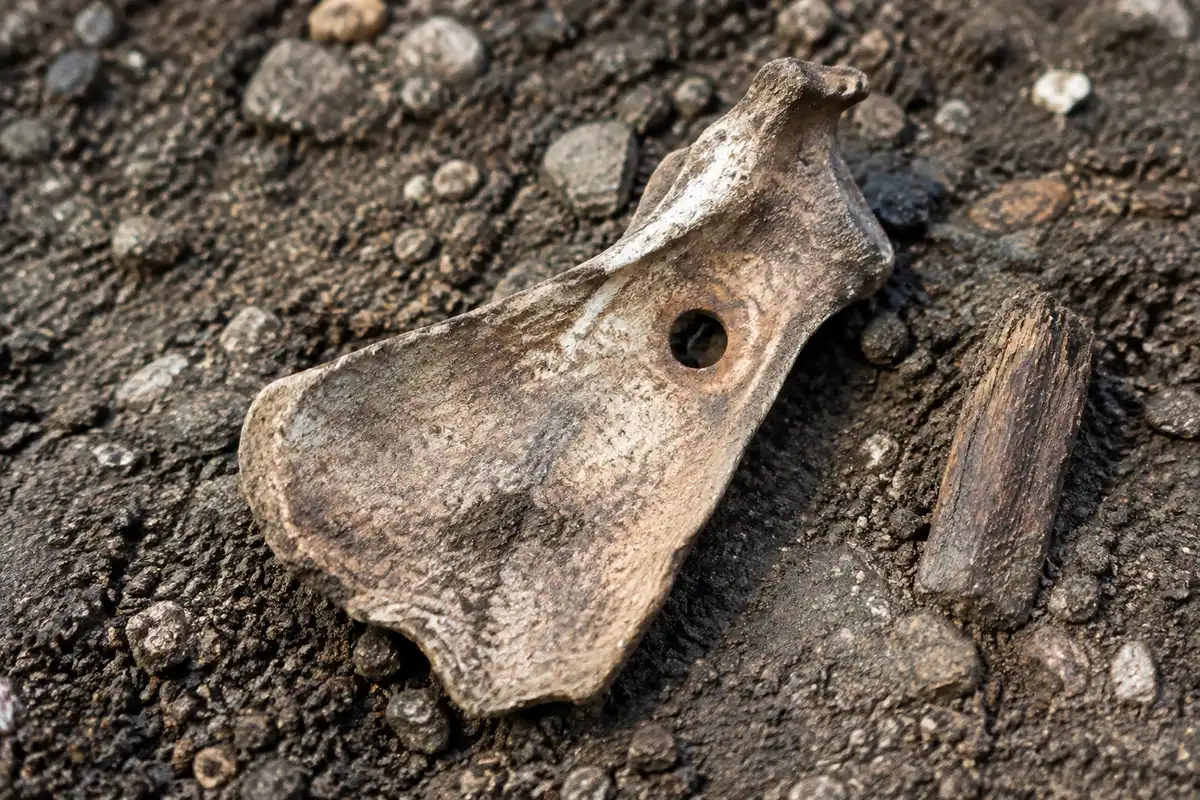
Archaeologists examined the partial skeleton, cataloged as Shanidar A, after its discovery in 2019. The remains include a mostly complete right hand, three ribs, six teeth and a left scapula. Near the rim of that shoulder blade researchers found a round perforation about 1.5 centimeters across and a circular fragment of bone that had been driven out.
Light-up digital shelf labels help Walmart shoppers and employees locate items
Former YMU Global exec opens London agency representing creators, including Topjaw’s Jesse Burgess
The team ruled out taphonomic causes such as animal chewing or insect burrowing and concluded the injury occurred around the time of death — what the authors call perimortem penetrating trauma. Their reconstruction indicates a projectile or thrusting implement entered the chest from the front at considerable speed and exited through the shoulder blade.
The wound’s shape and fracture characteristics match experimental injuries produced by wooden spears, the study says, rather than those made by stone-tipped points. That evidence led the authors to suggest the blow may have been an aimed hit to the heart. As lead author Emma Pomeroy of the University of Cambridge put it in a statement: “The position of the wound and the force required to push it right through the Neanderthal’s body bear the hallmarks of an intended kill shot directed towards the heart.”
Care before death
Although Shanidar A suffered a violent end, teeth from the same individual indicate a period of prolonged care. The six teeth are unusually worn; one front tooth was split during life and accumulated heavy tartar, yet the Neanderthal continued to use it for an extended time. The pattern suggests a serious facial trauma that fractured the lower front tooth and likely affected the jaw.

That survival after severe injury implies others helped the injured individual. “Surviving a blow that splits a tooth in this fashion, then continuing to live and eat for a period of at least a year and maybe more, would have required care and support from other Neanderthals,” Pomeroy said.
Co-author Graeme Barker, also at Cambridge, emphasized the limits of interpretation about the final moments. “All we can ever know about the end of this Neanderthal’s life is that it was violent, and came at the end of a wooden spear,” he said.
Context at Shanidar and broader implications
Shanidar Cave has long been central to debates about Neanderthal behavior because excavations recovered multiple deliberate burials there. Earlier claims of a “flower burial” at Shanidar have been questioned, but repeated interments at the site still indicate it held special significance for those who used it.
This is not the first mortally wounded individual found at Shanidar. Researchers previously described Shanidar 3, an older adult who died about 50,000 years ago and bore a deep cut to a rib. That injury was interpreted by some as consistent with a stone-tipped spear, possibly thrown by a modern human. Modern humans are thought to have reached parts of Europe by roughly 54,000 years ago, but the nature of interactions between groups remains uncertain.
Pomeroy noted the two stabbed individuals at Shanidar are separated by about 25,000 years and that repeated use of the cave for short-term occupation and burial makes coincidences possible. Still, the new evidence adds to a growing picture of Neanderthal life that included complex social behavior, risk-filled hunting, and instances of lethal violence.
Alternative explanations and expert caution
The authors are cautious about assigning motive. The perforation could reflect interpersonal violence, a hunting accident, or another kind of mishap. Rebecca Wragg Sykes, an archaeologist who was not involved in the study, highlighted a competing possibility: the hardened horn of a hunted animal. She told Live Science it would be useful to compare the injury to damage caused by a wild goat horn — the species most intensively hunted at Shanidar — to see if that could account for the trauma.
The study appears in Scientific Reports and is listed with a DOI: 10.1038/s41598-026-69193-z. Its authors report a combination of traumatic injury, signs of care during life, and evidence of deliberate burial — details that continue to refine our picture of Neanderthal behavior and social life.