Show summary Hide summary
A newly described small Jurassic bird from southeastern China appears to have been a ground‑dwelling predator rather than an agile flier. Researchers say the fossil combines avian and dinosaurian traits — including a curved, sickle‑like toe — that point to a running, meat‑eating lifestyle.
Where and when it was found
Paleontologists unearthed the specimen in 2024 within the Upper Jurassic Zhenghe Fauna of southeastern China. The animal lived roughly 150 million to 148 million years ago, a window that overlaps the earliest known birds in the fossil record. The research was published in Nature on Oct. 14.
Mid-stage trial shows Eli Lilly combo delivers bigger weight loss, company says
Russell Brand attorney asks watchdog to review his conduct after attacking reporter who exposed him

Anatomy that blurs the bird–dinosaur boundary
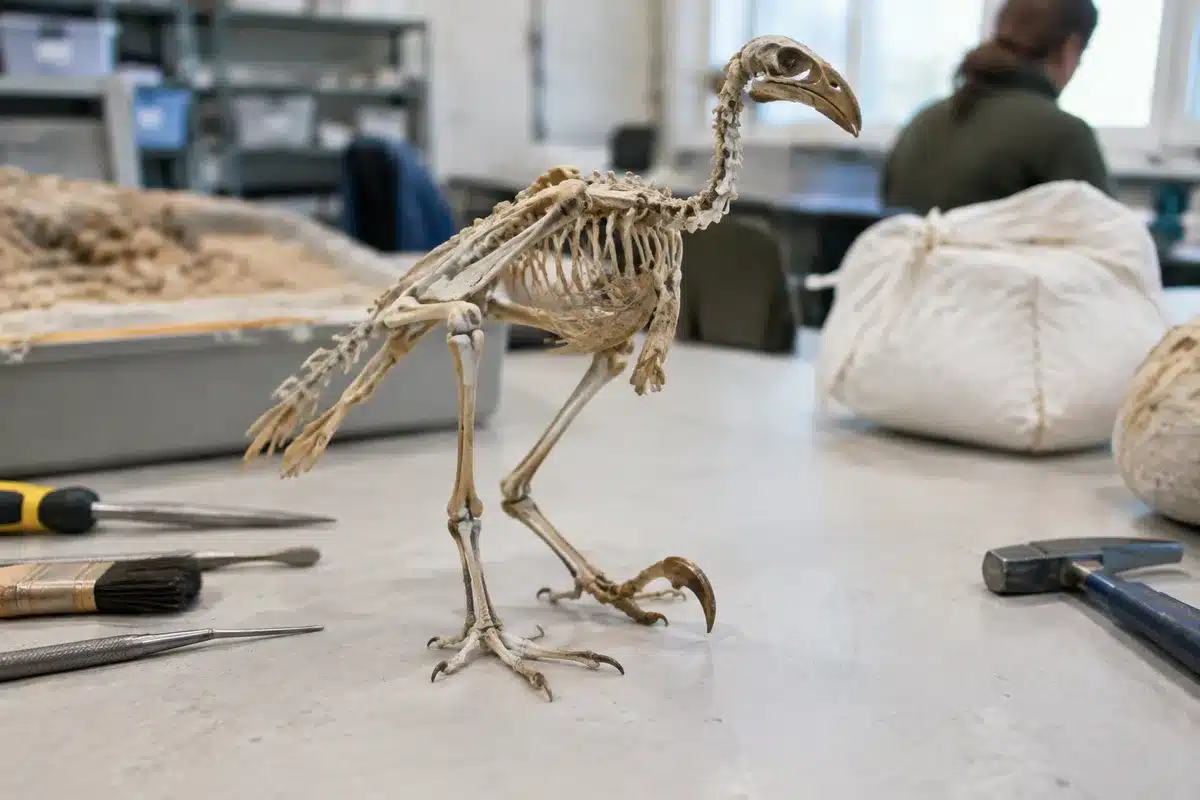
The species, named Yuezhuornis yangyuanensis, was small — about 0.8 kilograms, or roughly the weight of a crow. Its skeleton shows a mosaic of features seen in both early birds and in predatory deinonychosaurs such as Velociraptor.
Notable traits include forelimbs that were about one‑third shorter than the hind limbs and a highly mobile, curved second toe. The researchers describe the toe as hyperextensible, capable of forming a sickle‑like claw suited to grasping prey. The skull bones were slender and its teeth were sparsely spaced, reinforcing the view that it ate meat.
“It was probably as large as a crow,” said Min Wang of the Chinese Academy of Sciences. He added that the animal’s anatomy mixes dinosaur and bird characteristics: “its teeth, pectoral girdle, and especially the hyperextensible, ‘sickle‑clawed’ second pedal digit are similar to that of dinosaurs.”
A runner, not a tree‑dweller
Comparative analysis with 377 living bird species found that the limb proportions of Y. yangyuanensis most closely match those of terrestrial birds. The team concludes the animal was likely flightless and adapted for running on land rather than for life in trees or shallow water.

Researchers liken its overall proportions to a small carnivorous pheasant. “I think there are no directly comparable modern birds,” Wang said, underscoring how unusual the combination of features is among extant species.
What this means for avian evolution
The fossil narrows the apparent morphological gap between birds and certain maniraptoran dinosaurs. The authors argue the find shows a broader ecological and anatomical diversity among early avialans than previously recognized.
In an accompanying commentary, paleontologist Fernando Novas wrote that the evidence supports the idea that the ability to fly evolved multiple times among closely related dinosaur groups. He cited separate flight‑related adaptations in early birds, scansoriopterygids with membranous wing folds, and four‑winged microraptors. By contrast, Y. yangyuanensis appears to have followed a non‑flying, cursorial path.
“It highlights the extraordinary breadth of ecological and morphological diversification that took place close to the origins of avialans,” Wang said.
Study citation
Liming Xu, Min Wang, Ganmin Lin, Liping Dong, Ke Deng, Xing Xu, Honggang Du, Min Lin, Runsheng Chen & Zhonghe Zhou. Nature 658, 690–697 (2026). DOI: 10.1038/s41586-026-10972-z