

Show summary Hide summary
A major new study combining DNA and fossils redraws the bat family tree and changes where scientists think bats first evolved. By assembling hundreds of genomes and analyzing dozens of fossils, researchers say bats likely originated in Europe about 65 million years ago and developed both flapping flight and echolocation early in their history.
A dataset unlike any before
The paper, published Sept. 23 in Nature, uses the largest genomic-and-fossil compilation ever assembled for bats. The team produced high-quality genome assemblies for 41 species and incorporated 62 previously sequenced genomes, yielding a total of 103 bat genomes. Those genetic data were analyzed alongside a record collection of 44 fossils.
Ultra-thin women smoking cigarettes are making a comeback as a fashion trend
Windows Memory Diagnostic explained: what the test does and how to read results

More than 130 researchers contributed to the project under the international effort known as Bat1K. The collaboration brought together genomic sequencing, computational methods and paleontological evidence to resolve relationships among all 21 recognized bat families.
Europe as the likely cradle of bats
Previous hypotheses had placed the origin of modern bats in Asia, Africa or North America around 50 million years ago. The new analysis points instead to a European origin roughly 65 million years ago.
After emerging in Europe, the study suggests bats quickly spread into Africa, forming a Europe–Africa hub. From there they expanded into Asia, the Americas and Australia, eventually giving rise to the enormous diversity of more than 1,500 living species.
Flight and echolocation: early, not repeated
The researchers conclude that true flapping flight and advanced echolocation evolved early in bat evolution—about 50 million years ago—rather than appearing independently multiple times. That timing helps explain the lineage’s ecological success.
Key fossil evidence supports this view. A roughly 50-million-year-old specimen from southern France, assigned to the extinct species Vielasia sigei, shows features consistent with advanced echolocation and occupies one of the oldest branches on the reconstructed family tree.
Remarkable diversity and surprising traits
The dataset includes representatives of every bat family and some extraordinary species. Among them are the bumblebee bat (Craseonycteris thonglongyai), about 1 inch long and often cited as the world’s smallest mammal, and Madagascar’s sucker-footed bat (Myzopoda aurita), which uses suction pads to cling to smooth surfaces.
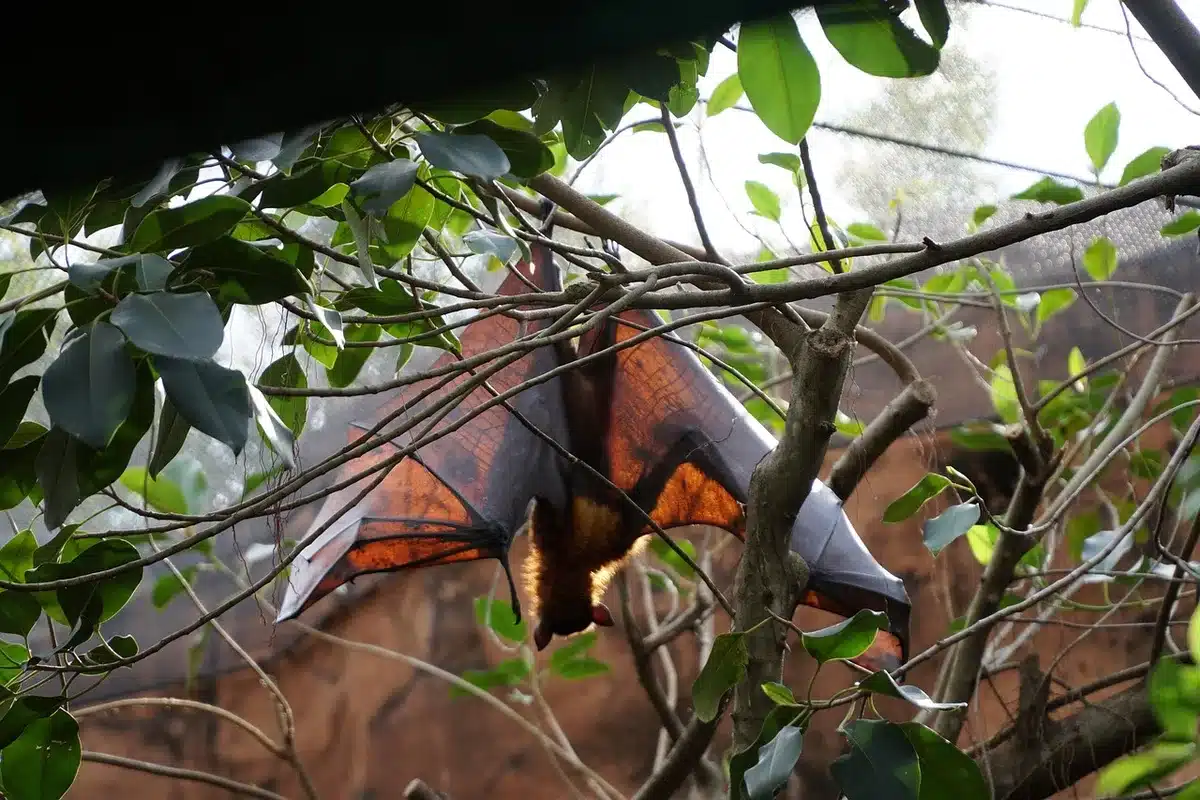
Bats are unique among mammals in performing true flight by flapping their wings. The study also highlights other unusual characteristics: many bat species live far longer than expected for their size—often eight to ten times longer—and show notable resistance to disease and low rates of cancer.
Research and conservation implications
Authors say the genomic resource established by the project will support follow-up studies into bat longevity, immune systems and disease tolerance, with potential relevance for human health if genetic mechanisms can be understood. The data should also aid conservation efforts by enabling genome-informed management of threatened species.
Lead investigators described the work as a foundational step rather than a final answer. The team has begun reconstructing the genome of the common ancestor of living bats, but they emphasize more research is needed to fill remaining gaps in the story.
Who did the work
The study was produced by a consortium of 137 scientists and affiliated with the Bat1K initiative. Corresponding authors and contributors include specialists in molecular evolution, phylogenetics and paleontology from institutions such as University College Dublin, the University of St Andrews and Stony Brook University.