Pacific Tribune
Gathering Art and Lifestyle News about Issues for the Pacific Basin
A lesson and strategy from Europe on Financing windfarms
Tuesday, December 23rd, 2008
0
This is an excellent article by an actual banker himself that is active in finance.
Daily Kos: How to keep on financing wind farms when banks have no money left.
Banks are engaged in a massive deleveraging exercise right now. One part of that has been much described and commented upon: the elimination of bad assets, either by taking the losses or by dumping them on the tax payer. The other part of the process is much more devious, as it means choking off new activity, even when sound, to avoid any new build up of assets. Debts that mature and are paid help shrink the balance sheet; giving new loans goes against that process and is thus avoided as much as possible by banks right now.
New lending activity is therefore much more scrutinized from a risk perspective, sees its conditions made much less favorable than they used to be, and is especially frowned upon for long term commitments, as long term liquidity is scarce and expensive.
First the bad news, then the bad news: China “no further investments!”
Wednesday, December 3rd, 2008
0
China to Shun West’s Finance Sector - NYTimes.com
HONG KONG — The chairman of China’s sovereign wealth fund said on Wednesday that China had no plans for further investments in Western financial institutions, nor did it have any plans to “save” the world through economic policies.The comments by Lou Jiwei, the chairman and chief executive of the China Investment Corporation are the clearest signal yet that after sustaining heavy losses on initial investments in the Blackstone Group, Morgan Stanley and Barclays, state-run Chinese institutions have no appetite for further purchases in this sector.
China yesterday announced its boldest interest rate cut since 1997
Thursday, November 27th, 2008
0
The Standard - Hong Kong’s First FREE English Newspaper
China yesterday announced its boldest interest rate cut since 1997 in a bid to cushion itself from the global financial crisis and help boost the world economy.
In a move seen as a response to the United States’ latest bailout efforts, the People’s Bank of China surprised the market by aggressively slashing the benchmark one-year interest rate for loans and deposits by 1.08 percentage points to 5.58 percent and 2.52 percent, respectively.
The cuts are effective today.
China: US treasury bonds ’still the best option’
Thursday, November 20th, 2008
1
US treasury bonds ’still the best option’
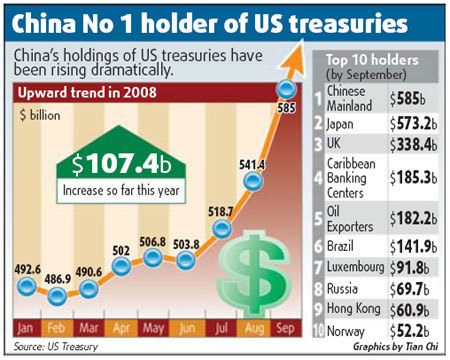
China is likely to continue increasing holdings of US treasury bonds even after becoming the No 1 holder because it is the best way to deploy its $1.9 trillion foreign exchange reserves, economists say.
On Monday, US Treasury data showed that China had replaced Japan to become the top holder of US treasury debt in September.
Toyota profits to plunge 74%
Monday, November 10th, 2008
0
asahi.com(朝日新聞社):Toyota profits to plunge 74% - English
Toyota Motor Corp. said Thursday it expects a 73.6-percent drop year on year in group operating profits through March, citing the soaring yen and falling overseas sales.The full-year projection was downgraded to 600 billion yen, the lowest since Toyota adopted U.S. accounting standards in fiscal 1998.
Group sales are forecast to fall 12.5 percent from a year earlier to 23 trillion yen.
Asian stock markets rally ….
Tuesday, October 28th, 2008
0
Oct. 29 (Bloomberg) — Asian stocks gained amid speculation Japan will cut interest rates and China will take steps to boost equities, adding to global efforts to revive confidence in financial markets.
Mitsubishi UFJ Financial Group Inc. climbed 10 percent after the Nikkei English News said the Bank of Japan may lower rates to 0.25 percent. Panasonic Corp., the world’s largest maker of consumer electronics, jumped 10 percent after profit beat its quarterly target. BHP Billiton Ltd. advanced after prices for metals and oil gained. The Dow Jones Industrial Average surged 11 percent yesterday, helped by expectations the U.S. Federal Reserve will cut interest rates later today.
Government to freeze its share sales to aid prices
Tuesday, October 14th, 2008
0
asahi.com(朝日新聞社):Government to freeze its share sales to aid prices - English
To ease selling pressure on domestic stocks, the government plans to freeze the sales of shares it acquired during past financial turmoil, Finance Minister Shoichi Nakagawa said Tuesday.It also intends to revive legislation to enable public-fund injections into faltering regional banks and extend a mechanism to protect life insurance policyholders with taxpayers’ money, he said.
The steps are the cornerstone of a policy package Nakagawa announced to cushion the blow from the global financial crisis.
World Financial Crisis News Roundup
Thursday, October 9th, 2008
0
| Stocks tumble after late sell-off |
| Dow plunges 679 to fall to lowest level in 5 years |
| Asian stocks plunge; Tokyo suffers worst fall in 21 years |
| Up to 50,000 overseas Filipino workers (OFWs) could be affected by the US-led global financial crisis, according to an assessment by the labor department. |
| Korean Tourists To CNMI Fill The Pinch As Currency Declines |
| Jakarta: Govt. to disburse Rp 25.9 t in emergency spending |
| Financial crisis: IMF draws up emergency bail-out plans for countries |
| Rudd calls for global deal to rescue markets |
| NZ, Bollard: We don’t need a rate cut yet |
| Chinese shares fall for 4th day, despite gov’t efforts to boost markets |
| Partial Nationalization of US Banks Considered |
Deepening US Financial Crisis: China Daily viewpoints
Thursday, October 9th, 2008
0
China cuts rates to ward off slowdown
China, following other economies, cut the benchmark deposit and lending rates by 0.27 percentage point Wednesday to anchor its economy amid a worsening global financial crisis. Fed’s Emergency Rate Cut  Japan Stocks Dive 9.4% Iceland on Brink of Bankruptcy World Economy to Slow Sharply Full Coverage
Japan Stocks Dive 9.4% Iceland on Brink of Bankruptcy World Economy to Slow Sharply Full Coverage
朝日新聞社:U.S. public funds key to recovery
Thursday, October 9th, 2008
0
asahi.com(朝日新聞社):U.S. public funds key to recovery - English
Share prices in Tokyo and elsewhere will not make a meaningful rebound until the United States decides to recapitalize ailing financial institutions with taxpayers’ money, economists say.
-
Blog Value

-
Translate
